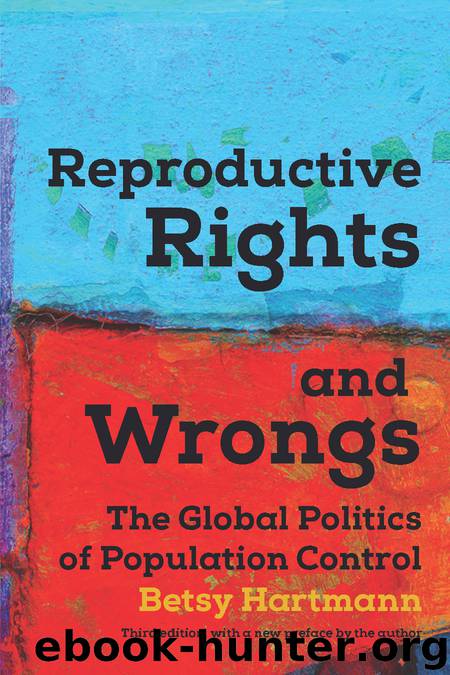
Reproductive Rights and Wrongs by Betsy Hartmann
Author:Betsy Hartmann
Language: eng
Format: epub
Tags: Women's Studies, ebook
ISBN: 978-1-60846-734-1
Publisher: Haymarket Books
Published: 2016-11-15T05:00:00+00:00
11
Hormonal Contraceptives
and the IUD
To millions of women throughout the world, hormonal contraceptives and the IUD have been presented as liberating technologies. In the West they were heralded as the key to the so-called sexual revolution, and in the Third World as the answer to unwanted pregnancies and high birth rates. The enthusiasm which accompanied their introduction helped to obscure, and still obscures, their drawbacks. In population control programs particularly, many women have been denied vital information about the risks of these contraceptives and have not received medical screening or follow-up care while using them. The result makes a mockery of informed consent.
Pushing the Pill
The Pill makes your breasts more beautiful and is good for everyone—including the tailors who have to make bigger brassieres.
—Slogan suggested by DR. MALCOLM POTTS, director of the International Fertility Research Program, and colleagues at
the 1977 Tokyo International Symposium on Population.1
The birth control pill was the first and is still the most widely used of the hormonal contraceptives. Today over 70 million women take the pill worldwide, making it the second most widely used reversible female contraceptive in the world after the IUD. The pill undoubtedly has many advantages. Used correctly, it is very effective in preventing pregnancy and can alleviate menstrual disorders. It is relatively easy to use and does not interfere with sex. Moreover, it is under women’s control—a woman must consciously decide to take the pill every day and can stop taking it if she suffers from side effects. This is a particularly important attribute given the recent trend toward taking control away from women.
The most common type of pill contains the synthetic hormones estrogen and progestin, similar to those produced in a woman’s ovaries during the menstrual cycle. These affect the pituitary gland, altering the body’s hormonal balance so that ovulation does not occur. The pill thus directly intervenes in one of the female body’s most important reproductive processes.
Fears of the population explosion, the impetus behind the development of the pill, also determined where the first clinical trials of the method took place. The Caribbean island of Puerto Rico was chosen because, in the words of three pill researchers, it is a “region in which population pressure is a public health problem.” In this particular study, undertaken in the late 1950s, one woman died from congestive heart failure and another developed pulmonary tuberculosis, but the researchers confidently asserted that “none of these effects could in any way be attributed” to the pill.2 (The pill is closely linked to circulatory disorders.) The ethical and scientific standards of the early pill studies in Puerto Rico in fact left much to be desired. One study even blamed most occurrences of side effects such as nausea, vomiting, and dizziness on psychological factors.3
Nevertheless, the studies convinced the FDA in 1960 to approve the first birth control pill, produced by Searle and marketed under the name of Enovid. By 1962 Searle had received reports of over 100 cases of thrombosis and embolism (circulatory disorders, notably blood-clotting) associated with use of the Enovid pill, resulting in eleven deaths.
Download
This site does not store any files on its server. We only index and link to content provided by other sites. Please contact the content providers to delete copyright contents if any and email us, we'll remove relevant links or contents immediately.
| Anthropology | Archaeology |
| Philosophy | Politics & Government |
| Social Sciences | Sociology |
| Women's Studies |
Cecilia; Or, Memoirs of an Heiress — Volume 1 by Fanny Burney(32558)
The Great Music City by Andrea Baker(32018)
Cecilia; Or, Memoirs of an Heiress — Volume 2 by Fanny Burney(31956)
Cecilia; Or, Memoirs of an Heiress — Volume 3 by Fanny Burney(31941)
We're Going to Need More Wine by Gabrielle Union(19046)
All the Missing Girls by Megan Miranda(16026)
Pimp by Iceberg Slim(14506)
For the Love of Europe by Rick Steves(14121)
Bombshells: Glamour Girls of a Lifetime by Sullivan Steve(14075)
Talking to Strangers by Malcolm Gladwell(13370)
Norse Mythology by Gaiman Neil(13363)
Fifty Shades Freed by E L James(13240)
Mindhunter: Inside the FBI's Elite Serial Crime Unit by John E. Douglas & Mark Olshaker(9342)
Crazy Rich Asians by Kevin Kwan(9292)
The Lost Art of Listening by Michael P. Nichols(7506)
Enlightenment Now: The Case for Reason, Science, Humanism, and Progress by Steven Pinker(7313)
The Four Agreements by Don Miguel Ruiz(6765)
Bad Blood by John Carreyrou(6621)
Weapons of Math Destruction by Cathy O'Neil(6279)
